The Importance of Family History to Our Society
We explore the importance of family unit history in helping you find belonging, and how records tin assist y'all discover the meaningful details of your ancestors' lives.
 Family can mean different things to different people. For some, it means to be with people who empathize and accept you unconditionally. For others, information technology is strictly those to whom they have a biological connection. Some of united states don't have ideal families, while others couldn't imagine their life without family unit. Virtually often, though, it'due south a mixture of each of these types of relationships.
When I recollect about my most ideal family relationships, I think of my dad's Germans-from-Russia Mennonite cousins, double cousins, aunts and uncles, grandparents… you get the idea. It's a big family with lots of endogamous connections—I mean, my grandparents are first cousins in one case removed, and they didn't even know each other before they were young adults and started dating. My favorite memories are of huge family unit reunions at a park with homemade ice foam, more kinds of pies than I could count, and a million and one family stories. I loved the stories and the food!
The Importance of Family History
Just what if you don't take a close, big family? What if you don't know your family stories? What if you've lost the connection yous in one case felt? Family history research can help you acquire about your roots, your cultural connections, ethnic identity–and can play an important office in helping yous find belonging.
Bringing Family unit History to Life
While genealogical inquiry requires learning about the births, marriages, and deaths of various ancestors, the most important aspects of these records, created only equally a byproduct of our ancestors living their lives, is that every particular on a tape tells a piece of a person's story. Beneath are some examples of common genealogical records, and the important details that may be gleaned from them:
Physical Description vs. Photo
Military machine draft cards, passenger lists, and naturalization papers are iii different tape types that include a concrete clarification of a person, which is the next best affair to finding an actual photograph. Many passenger lists also include the name of the person'southward nearest relation back dwelling and the name of someone they were joining in the United States. Naturalization papers include names of witnesses who could personally adjure to how long an ancestor had lived in this state and in a particular town. These relatives and friends were ones with whom people frequently associated. Learning about them would add to the analogy of your ancestor's life.
Census: More than a Locator Tool
In addition to showing exactly where an ancestor lived, censuses are full of other interesting facts. Depending on the census year, these records might include relationships, details about how many children a couple had versus how many children were living, how long a couple had been married, when a person arrived in the United states and his or her citizenship status, a person's occupational information, and even whether an individual endemic or rented a home. These fascinating details can paint a flick of twenty-four hours-to-day life. Don't forget to browse the surrounding entries: These people were your ancestors' neighbors, friends, and in some cases, extended family members.
What Church Did My Ancestors Attend?
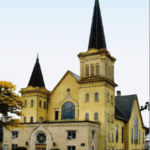
Outset Evangelical Lutheran Church, Racine. Courtesy of FirstRacine.org.
Religion is a sometimes-disregarded slice of this puzzle. Before governments began keeping records of common people, the only records that included everyone were church records—parish registers of infant baptisms, marriages, and burials. These also help fill in some of the blanks in the family story.
Finding Complete Family Groups
Yes, family size played into the dynamics of our ancestors' lives, but organizing complete family unit groups is also important because every nascency or baptism record created for a child can give details, not simply about that child, simply likewise about the age, status, occupation, and residence of the child's parents. Did they move around a lot? Did they stick to i profession? Did they lie virtually their ages? Were they married more than once? The answers to each of these questions assistance fill up in the picture of who our ancestors were.
Newspapers
 Order columns containing the juiciest of the local gossip; obituaries that shared the exploits or accomplishments of our dear departed; local court cases, some over holding line disputes and others much more than scandalous—each of these types of articles showed up in your ancestors' local newspapers. Sometimes they were even the subject area of the article. And then dig deep if you want to find those family stories! Don't merely search for John Smith'southward name—search for his wife, his children, his siblings, anyone whose life choices might have affected his. And recall, if the family lived in a German-speaking community, for case, then the chances are high that the all-time source of this type of information is going to exist the local German-language newspaper. Don't overlook it just because it's written in a foreign linguistic communication. Embrace the cultural and ethnic diversity and become aid with the language if you need it!
Boondocks and County Histories
Town and county histories feature biographies of prominent citizens, which might include ancestors if they were founding members or prominent members of the local community. These resources can tell you whether your antecedent was ever involved in local government. Merely even if your ancestors were "just farmers," these histories shed low-cal on the community in which they lived Was the town small-scale or big? Were the farmers an afterthought or were they the courage of the community? What were the local holiday celebrations like? Tin you imagine your ancestor attending the Independence Mean solar day (Quaternary of July) celebration based on a description of the festivities? This type of data puts our ancestors in context of what was going on around them at the time.
Local Historians
Local historians frequently have access to the collections of records from which the boondocks and county histories were compiled. They often have information and stories about the local families who have been there for a long time, and even historical photographs of the area or of your ancestor's domicile. You lot can commonly find this person by contacting the local library or genealogical guild.
Walking Where They Walked
Once your antecedent'southward life is put in context, it is an amazing treat to be able to walk a twenty-four hours in his or her shoes. Visiting an antecedent's home in person, walking Master Street in his or her town, or taking a genealogy tour to their homeland are things that will bring home to you the amazing lives your ancestors lived at that place.
If you are seeking connection, and want to learn who an ancestor actually was, don't be satisfied with only finding a name, a appointment, and a identify. Seek out every record created by (or for) your antecedent. Reflect upon the importance of family history and what every particular in each record meant for your ancestor in his or her story… and what it means for you.
Our team of professional genealogists are experienced at pouring over every tape and shred of evidence to weave together the details of your ancestors' lives into a meaningful narrative that volition be cherished for generations to come. Get started today by requesting your free quote.
Subscribe for weekly posts
- Bio
- Latest Posts

After earning her family history degree in 2005, Marissa worked in Deoxyribonucleic acid genealogy, forensic genealogy, and as a personal family history researcher for clients. She earned her accreditation through ICAPGen in 2011 for the region of Frg. She also excels at solving U.Due south. and Canadian clearing problems (finding the family's European hometown), Jewish and Holocaust research, French, Polish, Russian, Austrian, and Hungarian, along with many other countries in Central and Eastern Europe.
witmerariestabox1976.blogspot.com
Source: https://www.legacytree.com/blog/importance-family-history
0 Response to "The Importance of Family History to Our Society"
Post a Comment